


Views: 0 Author: Site Editor Publish Time: 2026-01-20 Origin: Site


In industrial production, manufacturing, and daily application scenarios, the performance of cutting tools directly affects work efficiency, finished product accuracy, and production safety. Round Blades, with their unique structural design, balanced force performance, and wide adaptability, have become an indispensable core cutting tool in various industries. Compared to other shapes of blades, circular blades achieve efficient operation through rotary cutting, with uniform force on the circumference of the blade, which can reduce cutting resistance and energy consumption, as well as ensure a smooth and flat cut. They are suitable for cutting various materials such as paper, film, metal foil, textiles, plastics, etc. and play an important role in fields such as printing and packaging, metallurgy and chemical industry, textile and clothing, and food processing.
The most intuitive feature of a circular blade is its shape. A circle is a highly symmetrical and stable geometric shape. When rotated around its center, every point on the blade can be traced along the cutting path at the same angular velocity, providing a natural physical basis for uniform and smooth cutting. Unlike reciprocating blades, rotary cutting allows for continuous motion, avoiding backlash and greatly improving work efficiency. From the smallest handheld cutting tools to massive industrial production lines, the principle of rotary cutting remains consistent, with only differences in scale and accuracy. The diameter, thickness, center aperture, and cutting edge angle of a circular blade together form its personalized "identity" identification, determining which material it is most suitable for and what cutting effect it can achieve.
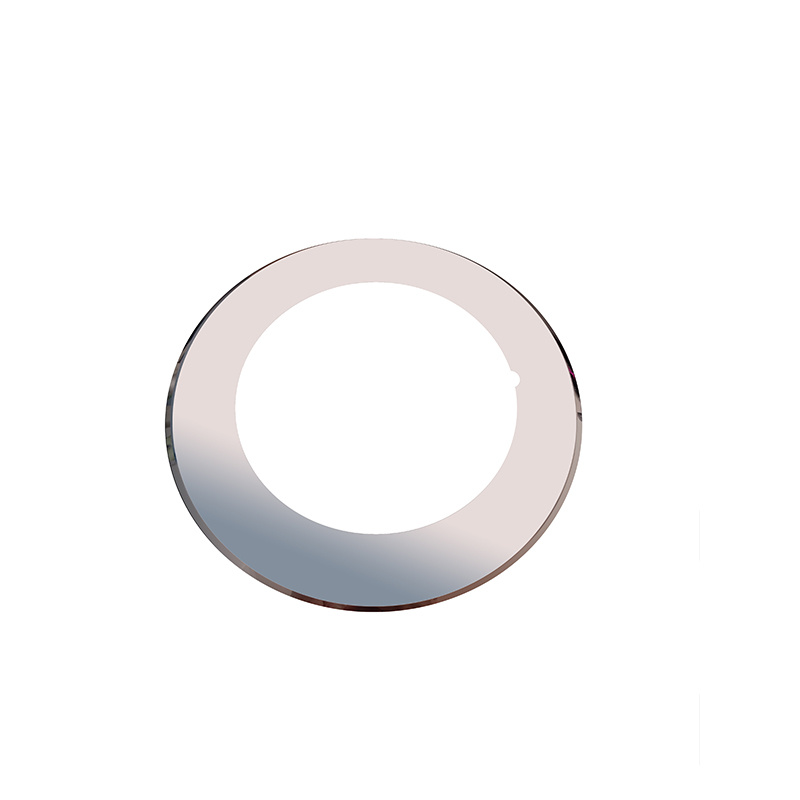
The core advantage of Round Blades lies in its scientific structure and blade design, which is disc-shaped as a whole with blades distributed around the circumference. It is connected to the driving equipment through a central axis hole and relies on the cutting force generated by high-speed rotation to complete the cutting operation. This structure ensures that the blade receives uniform force during operation, avoiding problems such as blade breakage and deformation caused by excessive local force, and extending its service life. The angle and thickness of the blade need to be precisely designed according to the characteristics of the cutting material. For lightweight materials such as paper and film, thinner blades and sharp cutting angles are usually used to reduce material pulling and deformation during the cutting process; For materials with high hardness such as metal foil and hard plastic, it is necessary to increase the thickness and toughness of the cutting edge to improve cutting strength and ensure smooth cutting. Some Round Blades also undergo special treatments on the blades, such as quenching, coating, etc., to further enhance hardness, wear resistance, and corrosion resistance, and adapt to complex working conditions.
The charm of circular blades lies in their extremely wide and highly specialized applications. In our daily life, we can see it in the food processor in the kitchen, the rotary knife of manual Paper Cuttings, and the hedge trimmer in the garden. In the fields of handicrafts and woodworking, from traditional rotary engraving knives to modern electric circular saws and table saws, circular blades are the core for achieving precise cutting and shaping. In the grand picture of modern industry, circular blades are ubiquitous: in the paper industry, huge slitting knives precisely cut large paper rolls; In the textile industry, high-speed rotating circular knives are used to efficiently cut fabrics; In metal processing, alloy circular saw blades are the main force for cutting profiles and pipes; On the cutting line of plastic film, printed materials, and composite materials, high-precision circular knives ensure the neatness and efficiency of the cutting edges. Different application scenarios have distinct requirements for the characteristics of blades - food processing requires hygiene and corrosion resistance, metal cutting pursues wear resistance and impact resistance, and precision cutting emphasizes ultimate sharpness and dimensional stability. This has driven the development of various specialized branches of circular blades.
With the improvement of automation and precision production levels in various industries, the design and process of Round Blades are constantly being optimized. To adapt to high-speed automated production lines, the dynamic balance performance and stability of the blades are further improved, reducing vibration and noise during high-speed operation; Customized Round Blades are gradually becoming popular for cutting needs of special materials. By accurately matching material characteristics to design blade parameters and materials, cutting efficiency and quality are improved; At the same time, the application of environmentally friendly materials and processes is also increasing, which not only meets the industry's environmental requirements, but also adapts to the high standard demands of fields such as food and medicine. These optimizations make Round Blades more adaptable to the diversified and efficient needs of modern production, becoming an important tool for promoting production upgrades in various industries.


