


Views: 0 Author: Site Editor Publish Time: 2026-01-27 Origin: Site


Wood Chipper Blades are the core cutting components of wood cutting equipment, specifically used for cutting various types of wood and wood waste. With sharp edges, excellent wear resistance, and adaptability, they are widely used in wood processing, papermaking, biomass energy, landscaping, furniture manufacturing, and other fields. As the "core blade" of wood cutting equipment, Wood Chipper Blades directly determine the efficiency of wood cutting, the particle size accuracy of wood chips, and the overall operational stability of the equipment. Its quality and performance not only affect the continuity of production, but also are related to processing costs and production safety. Unlike ordinary cutting blades, Wood Chipper Blades need to continuously withstand the impact, friction, and compression of wood, and adapt to wood materials with different hardness and humidity. Therefore, there are more stringent requirements for material selection, structural design, and processing accuracy, making them an indispensable key component in the wood deep processing industry.
From the perspective of design form and functional principles, the design of wood cutting machine blades fully considers the physical properties and crushing process requirements of wood. Common blade shapes include straight blade, hook blade, and spiral blade. The straight blade structure is relatively simple and easy to manufacture. It mainly cuts wood through sharp edges and is suitable for general occasions where the uniformity of wood chip size is not extremely high. Hook shaped blades are designed with specific hook or groove structures at the cutting edge, which can more effectively "bite" and tear wood fibers, especially suitable for processing irregularly shaped raw materials such as branches and boards, and can improve grasping ability and initial crushing efficiency. The design of the spiral blade is even more exquisite, with its cutting edge distributed in a spiral line. This structure can make the blade's contact with the wood smoother and more gradual during rotation, not only reducing the instantaneous impact load during cutting, making the equipment run more smoothly and with lower noise, but also promoting the smooth flow of wood in the crushing chamber, avoiding blockage, and helping to form wood chips with more consistent dimensions.
The manufacturing process of Wood Chipper Blades has strict control requirements for its accuracy and performance. Currently, the commonly used manufacturing processes in the industry mainly include core links such as forging, heat treatment, mechanical processing, and blade grinding. Each link must strictly follow the standards to ensure that the blade quality meets the standards. The forging process is the core link in the production of Wood Chipper Blades. By applying high temperature and high pressure to the metal billet, it undergoes plastic deformation to form the desired blade shape and size, while refining the metal grains, improving the density and mechanical properties of the blade, and reducing internal defects such as pores and cracks. The forged blade needs to undergo strict heat treatment processes, including quenching, tempering, etc. By precisely controlling the heating temperature, insulation time, and cooling rate, the hardness, toughness, and wear resistance of the blade are optimized to make the cutting edge sharp and not easily damaged, meeting the high-strength operation requirements of wood cutting.
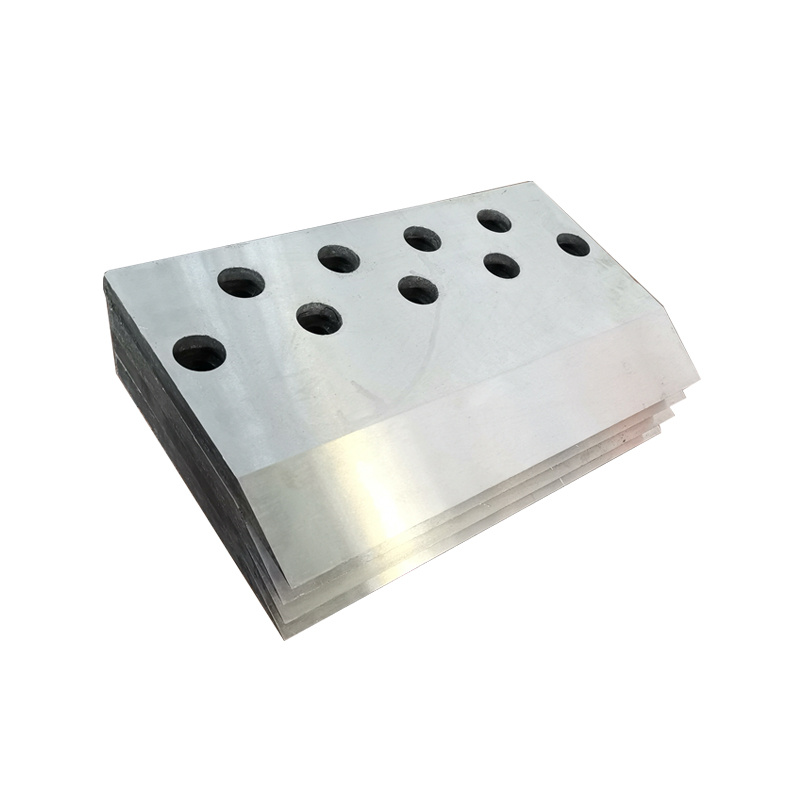
In industrial production and practical applications, Wood Chipper Blades have a wide range of application scenarios, covering almost all industries that require wood cutting processing. Their strong adaptability and high cutting efficiency provide strong guarantees for deep wood processing. In the wood processing industry, Wood Chipper Blades are widely used in equipment such as wood chippers and crushers to process logs, branches, etc. into uniform wood chips, providing qualified raw materials for subsequent processes such as panel processing and furniture manufacturing. Their performance directly affects the efficiency and product quality of wood processing. In the papermaking industry, Wood Chipper Blades are key components in the pulp making process, used to process wood into fine wood chips for subsequent cooking, bleaching, and other processes. The uniformity of the wood chips directly affects the quality of pulp and papermaking efficiency.
With the advancement of wood processing technology and the continuous improvement of industrial demand, the technology of wood cutting machine blades is also constantly evolving. The development of materials science has brought about better performance in the manufacturing technology of steel and composite materials, as well as more precise processing equipment and process control methods, such as laser cutting and five axis linkage CNC machining, which have achieved new heights in the manufacturing accuracy and consistency of blades. In terms of design methods, computer-aided design and finite element analysis software are widely used for structural optimization and stress simulation of blades, helping to design more efficient, durable, and energy-saving blade profiles.


