Views: 0 Author: Site Editor Publish Time: 2026-01-12 Origin: Site


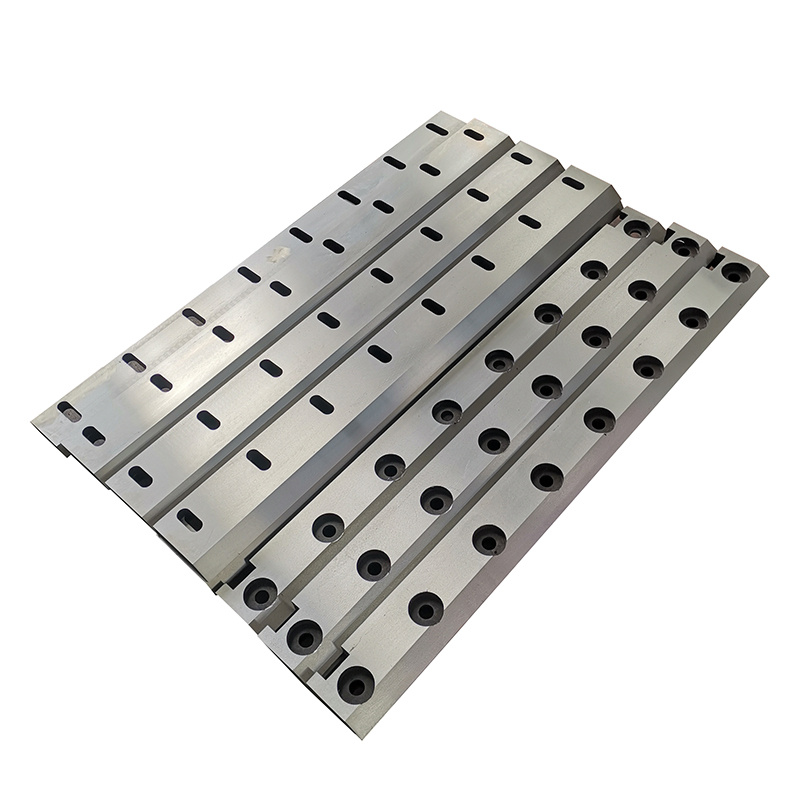
In the vast industrial field of solid material processing, efficient crushing of materials is a key first step in many processes, from mining gravel to waste resource recycling, from plastic recycling to urban solid waste disposal. The core executor of this crushing action is the Crusher Blades of various crushing equipment -crusher blades. These seemingly simple metal components are actually subjected to extremely complex mechanical and wear tests, and their design and performance directly determine the efficiency, energy consumption, and output quality of the entire production line.
The core performance of Crusher Blades relies on high-quality material selection, with differentiated material solutions corresponding to different application scenarios. For materials with high hardness such as ore and granite, blades are often made of high manganese steel, alloy steel, and other materials. These materials have excellent impact toughness and wear resistance through special heat treatment processes, which can prevent cracking under high-intensity impact and resist material wear and tear; For low to medium hardness materials such as plastic, rubber, and paper, chrome steel and stainless steel blades are more suitable. Their cutting edges have higher sharpness, can achieve precise cutting, and have a certain degree of corrosion resistance, which can be adapted to damp or chemical medium containing material environments. In addition, some high-end blades will adopt surface coating technology by spraying wear-resistant coatings such as tungsten carbide and titanium nitride to further enhance surface hardness, extend service life, and reduce replacement frequency.
The geometric shape of the blade design is another key factor determining the crushing efficiency and product particle size. The size of the blade angle directly affects the ability to cut into the material and its own strength - smaller blade angles are sharper, making cutting easier, but lower in strength, making it easier to roll or break the blade; Larger blade angles are more sturdy, but may increase energy consumption. The arrangement of blades (such as spiral arrangement, staggered arrangement), quantity, and blade tip linear velocity jointly determine the movement trajectory, residence time, and force exerted on the material in the crushing chamber, ultimately affecting the crushing ratio, production capacity, and product particle size distribution. An excellent design requires finding the optimal balance between crushing force, energy consumption, wear uniformity, and product control. For example, in the cutting and crushing of plastic or scrap metal, a "scissor" design consisting of a moving blade and a fixed blade can achieve clean cutting with low energy consumption, reducing dust and over crushing.

Accurate adaptation to application scenarios is a prerequisite for the performance of Crusher Blades. In the field of mining, blades need to withstand high-intensity impact and severe wear, with a focus on ensuring structural stability and wear resistance; In the field of construction waste recycling, the material composition is complex (including concrete, steel bars, wood, etc.), and the blades need to have impact resistance, wear resistance, and certain fatigue resistance to avoid damage caused by mixed materials; In the field of plastic processing, the blade needs to maintain a sharp cutting edge to ensure the uniformity of plastic particles, and the material needs to have anti adhesion properties to avoid plastic melting and adhering to the cutting edge; In the field of wood processing, blades need to have good cutting performance, be able to quickly cut materials such as wood and branches, and have anti passivation ability at the cutting edge to reduce polishing frequency.
In practical applications, the efficiency and lifespan of crusher blades do not exist in isolation, but are closely related to the characteristics of the material being processed. The hardness, abrasion resistance, toughness, humidity, viscosity, and the presence of unbreakable foreign objects (such as metal parts) of materials can have completely different effects on blades. The primary task of crushing blades for granite is to resist high abrasion; When dealing with waste tires or plastic film blades, more attention should be paid to resisting fatigue and preventing entanglement and adhesion. Therefore, the selection of blades under specific working conditions must be based on a full understanding of material properties, and there is no "one size fits all" blade that can adapt to all scenarios.
In summary, crusher blades are the precise technological crystallization hidden behind rough crushing behavior. It integrates material science, mechanical design, process technology, and application wisdom, and performs the most direct confrontation and transformation between wear and breakage. Every piece of qualified material produced bears traces of microscopic wear on the blade edge. Understanding and valuing this critical vulnerable component, through scientific selection, correct use, and careful maintenance, enables its performance to be fully utilized. This is a solid foundation for ensuring the stable, efficient, and economical operation of various crushing production lines, and is also a subtle but important part of promoting the development of the solid material processing industry towards higher efficiency, energy conservation, and sustainability.