Views: 0 Author: Site Editor Publish Time: 2026-01-04 Origin: Site


In the symbiotic landscape of humans and nature, the growth, replacement, and reuse of trees constitute an eternal cycle. The conversion of sturdy branches and discarded wood into usable fragments or composting materials relies on a powerful and efficient mechanical core—the wood chipper. Inside this powerful machine, the key actors that truly execute the "breaking down" and achieve the transformation of material forms are the seemingly simple yet crucial wood chipper blades. They are the intersection of strength and precision, and are the first process that gives new life to discarded wood.
In fields such as landscape maintenance, wood processing, and biomass energy production, wood chippers are crucial equipment for enhancing operational efficiency. As the core working component of a wood chipper, Wood Chipper Blades play a pivotal role. Their performance directly determines the wood chipping effect, operational efficiency, and equipment service life. High-quality Wood Chipper Blades can easily handle various types of wood materials, from branches and trunks to wood chips, achieving efficient crushing. This lays a solid foundation for subsequent operational steps, making them indispensable accessories in related industries.
The working principle of wood chipper blades is purely based on mechanical applications, yet it is filled with ingenious considerations. Typically, the blades are firmly mounted on a high-speed rotating rotor or roller. When wood is pushed into the crushing chamber by the feeding system, it immediately encounters these rotating sharp blades. Cutting is not the only action; in many cases, the design of the blades focuses more on "splitting" and "tearing". The thick blade body provides momentum for impact, while the specially ground and sharpened cutting edge is responsible for cutting into the fiber structure of the wood. Some blades are designed with hooked or hammer-like protrusions, which can pull and strike while cutting, effectively processing wood with branches or knots. This rough and direct method requires the blades themselves to possess extraordinary toughness. Every contact with wood is a severe test for the blade material, heat treatment process, and structural design.

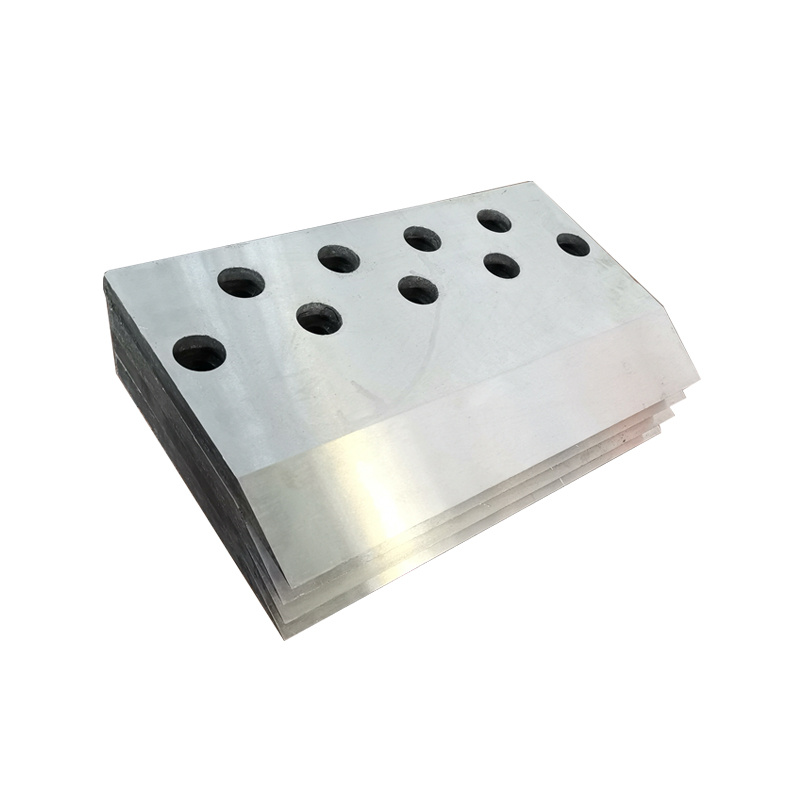
The core advantage of Wood Chipper Blades stems from their special material selection and precision machining processes. To cope with the high-intensity impact and friction during the wood crushing process, most Wood Chipper Blades on the market are made of high-strength alloy steel or wear-resistant tool steel. These materials possess excellent hardness, toughness, and wear resistance, maintaining their sharpness and reducing blade wear during long-term high-intensity operations. Furthermore, Wood Chipper Blades processed through professional heat treatment further enhance the comprehensive mechanical properties of the material, enabling them to easily cut through hard wood fibers while avoiding issues such as chipping or breaking during impact, thus ensuring the continuity and safety of operations.
Therefore, the material and craftsmanship of the blade directly determine the cornerstone of its lifecycle. The steel used to manufacture the blade is not ordinary; it requires a delicate balance between high hardness and good toughness. High-carbon steel or special alloy steel are common choices, which undergo precision forging to achieve a dense and uniform internal structure. Subsequently, the most critical heat treatment process comes into play: quenching is used to impart extremely high hardness to the blade edge to maintain its sharpness, followed by tempering to eliminate internal stress and impart sufficient toughness to the blade body to avoid fracture during impact. The final grinding angle of the blade edge is a practical science - if the angle is too small, the blade edge is sharp but prone to curling and chipping; if the angle is too large, it has high strength but increased cutting resistance, resulting in reduced efficiency. An excellent blade is a work created by the combination of materials science, metallurgy, and practical experience. Its mission is to maintain effective cutting performance throughout the long process of wear and tear.
The application scenarios of Wood Chipper Blades span multiple industries. In landscape maintenance, it can quickly crush trimmed branches and fallen leaves, reducing the amount of waste that needs to be removed. The crushed wood chips can also be used for garden fertilization, achieving resource recycling. In the wood processing industry, Wood Chipper Blades process logs into uniformly sized wood chips, providing raw materials for subsequent production such as wood-based panels and paper making. In the field of biomass energy, it can crush various types of wood waste into small particles, which can be used as fuel for biomass power generation and heat supply, supporting the development of green energy. With the continuous improvement of environmental protection requirements, Wood Chipper Blades play an increasingly important role in the field of resource recycling and utilization, providing strong support for promoting the green transformation of the industry.