


Views: 0 Author: huaxin blade Publish Time: 2026-10-20 Origin: Site


Ask five operators what makes a good set of blades and you will hear five different answers, but one word comes up almost every time: hardness. It sounds simple — the harder the blade, the better it cuts, right? Not quite. In real crushing work, hardness is a balancing act. Go too soft and the cutting edge wears away fast, so you are forever stopping to change blades. Go too hard and the steel gets brittle, and a single hidden nail or piece of stone can chip a blade into a jagged mess. The right answer sits somewhere in the middle, and it depends heavily on what you are feeding the machine. This article breaks down the hardness ranges that actually work for heavy-duty crusher blades for wood, what the trade-offs are, and how to choose the level that matches your job.
It helps to start with a simple truth: hardness is about resisting wear and penetration, while toughness is about absorbing shock without cracking. A blade can be very hard and very brittle at the same time. In wood crushing, your blades take a strange mix of punishment — clean softwood cuts easily, but nails, bark, stones, frozen timber, and the occasional concrete chunk all show up. A blade that is optimized purely for hardness will stay sharp longer on clean material, but it will also break more easily on the surprises. That is why almost every serious blade specification talks about both hardness and impact toughness, not hardness alone.
Hardness for steel blades is usually measured on the Rockwell C scale (HRC). For heavy-duty crusher blades for wood, the practical range mostly falls between 48 and 62 HRC, with different jobs pulling in different directions.
Typical hardness ranges for heavy-duty wood crusher blades
Hardness Range | Suitability | Wear Resistance | Impact Toughness | Typical Material |
|---|---|---|---|---|
48–52 HRC | Softwood, light recycling | Moderate | High | Alloy tool steel |
53–57 HRC | General mixed wood waste | Good | Good balance | High-alloy tool steel |
58–62 HRC | Hardwood, abrasive feeds | Very good | Lower | High-carbon tool steel |
The middle band, roughly 53 to 57 HRC, is the most common recommendation for a general-purpose machine that sees mixed wood waste. It holds an edge well enough to keep production steady, while still forgiving the occasional hard impact that would crack a harder blade.
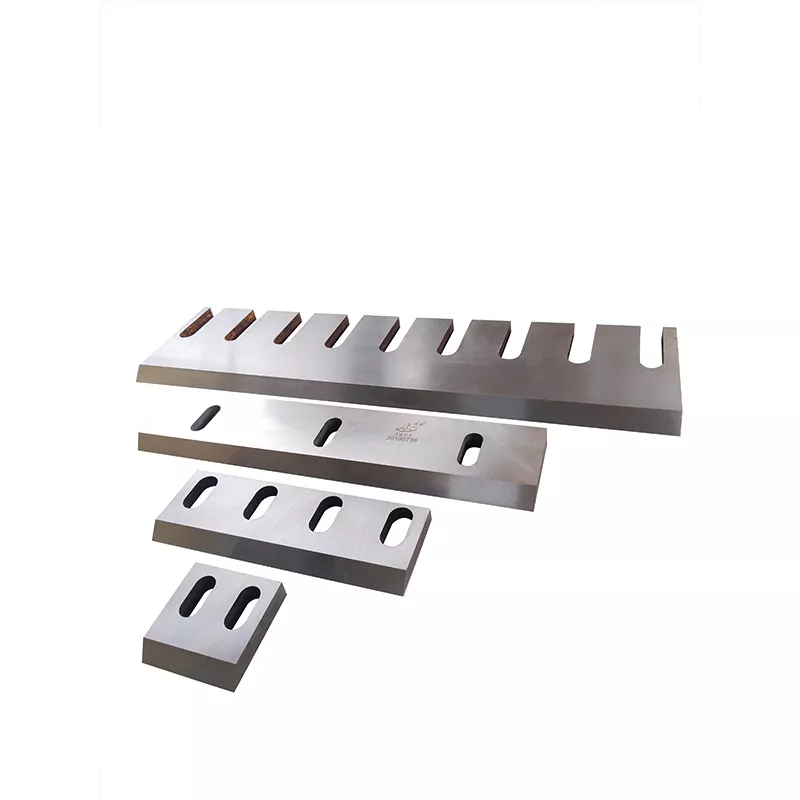
The biggest variable in choosing hardness is what your machine actually swallows. Different feed types punish the cutting edge in different ways.
Clean, dry softwood rewards a harder blade, because there is little shock and mostly gentle abrasion. Higher hardness here extends sharp life noticeably.
Mixed demolition and construction waste brings nails, screws, and stone. This feed favors a tougher, somewhat softer blade that can shrug off impacts instead of chipping.
Frozen or dense hardwood sits between the two. It abrades hard but also delivers impact, so a balanced hardness around 55 HRC is the usual sweet spot.
Rubber, plastic, or other non-wood contaminants add their own wear patterns. Harder steel resists abrasion better, but you still want enough toughness for the stray metal.
The pattern is consistent: cleaner feed lets you run harder blades; messier feed pushes you toward toughness.
Hardness does not work in isolation — it combines with how the blade is shaped and how it is mounted. A thick, slow-speed blade can run higher hardness because the geometry gives it extra support. A thin, high-speed blade relies more on toughness because it takes sharper, more frequent impacts. This is why you cannot simply copy a hardness number from one machine to another. The same crusher blades for wood that work on one shaft configuration may be a poor match on another. If you are replacing a worn set, the safest move is to match the hardness of the original equipment — or ask the manufacturer for the range that suits your specific rotor speed and feed size.
How blade geometry affects the best hardness choice
Blade Type | Typical Rotor Speed | Recommended Hardness | Reason |
|---|---|---|---|
Thick slow-speed blades | Low | 53–57 HRC | More material support, more impact |
Thin high-speed blades | High | 48–53 HRC | Higher toughness for repeated shock |
Heavy breaker knives | Medium | 55–60 HRC | Balance of abrasion and impact |
Hardness is not just a target number at the surface; it has to be uniform through the blade, or at least consistently controlled where the cutting edge does its work. Proper heat treatment matters more than chasing a single headline number. A blade that reads 56 HRC at the edge but drops off unevenly underneath will wear in patches and produce an unpredictable cut. When you evaluate crusher blades for wood, ask how the hardness was achieved and whether the treatment is consistent across the full blade, not just at the point. This is one of those details you cannot see in a photo, but it determines whether a blade lasts for weeks or for months.
Even with good planning, you can land on the wrong hardness. The blades will usually tell you before they fail completely.
Rapid dulling with no chips points to steel that is too soft for the abrasion it is seeing.
Visible chipping or cracking at the edge points to steel that is too hard for the impact load.
Uneven wear across the cutting edge often means inconsistent heat treatment or a mismatch between hardness and feed.
Excessive blade temperature can signal friction from a wrong hardness-and-geometry combination.
None of these are mysterious failures. They are the blade telling you the balance is off, and adjusting hardness — or feed handling — usually fixes it.
Q1: What is the ideal hardness for crusher blades for wood in heavy-duty work? For general mixed wood waste, roughly 53 to 57 HRC gives the best balance of wear resistance and impact toughness. Cleaner feeds can use higher hardness, while very contaminated feeds favor a tougher, slightly softer blade.
Q2: Why does a harder wood crusher blade sometimes break faster? Harder steel resists abrasion but is more brittle. Under impact from nails, stones, or frozen timber, a very hard blade can chip or crack instead of flexing. Hardness and toughness are different properties, and heavy crushing needs both.
Q3: Should I match the hardness of my original wood crusher blades? Yes, in most cases. The original blades were specified for your rotor speed and feed type. Matching that hardness keeps performance predictable. If you change feed material significantly, adjust hardness accordingly rather than guessing.
Q4: Does higher hardness always mean a longer blade life? No. Higher hardness extends life only on clean, low-impact feed. On abrasive or contaminated material, a balanced-hardness blade usually outlasts a very hard one because it survives impacts that would chip a harder edge.
Q5: How do I know if my crusher blades for wood are too hard or too soft? Watch the failure pattern. Rapid dulling without chipping usually means too soft. Chipping, cracking, or uneven wear usually means too hard or inconsistent heat treatment. Adjust the hardness or clean the feed accordingly.


