


Views: 0 Author: huaxin blade Publish Time: 2026-08-11 Origin: Site


Many factory operators assume all wood materials create the same level of abrasion on crushing equipment. In reality, softwood and hardwood have vastly different physical properties that directly impact blade lifespan. A set of standard crusher blades for wood can maintain sharpness for months when handling pine, cedar, or other softwoods. But when switched to oak, maple, teak, or dense industrial hardwood waste, blade performance declines noticeably in just weeks. The gap in durability is not caused by poor blade quality alone, but by multiple hidden operational and material factors.
To understand the wear mechanism clearly, it is necessary to master the basic industrial parameters of mainstream crushing blades. These standard values define the blade’s hardness, tolerance, and applicable scenarios, and also explain why hardwood processing easily exceeds the normal load limit of ordinary blades. Below are industry-recognized parameters for general wood crushing blades:
Parameter Item | Standard Specification | Wear Performance Explanation |
|---|---|---|
Main Material | 65Mn / 42CrMo Alloy Steel | Basic wear resistance for conventional softwood crushing |
Hardness (HRC) | 52–58 HRC | Sufficient for low-density wood, insufficient for dense hardwood |
Applicable Wood Density | ≤0.55g/cm³ | Most hardwoods exceed this density threshold |
Average Service Life (Softwood) | 3–5 months | Stable service life under standard working conditions |
Average Service Life (Hardwood) | 2–4 weeks | Sharp drop due to high density and fiber toughness |
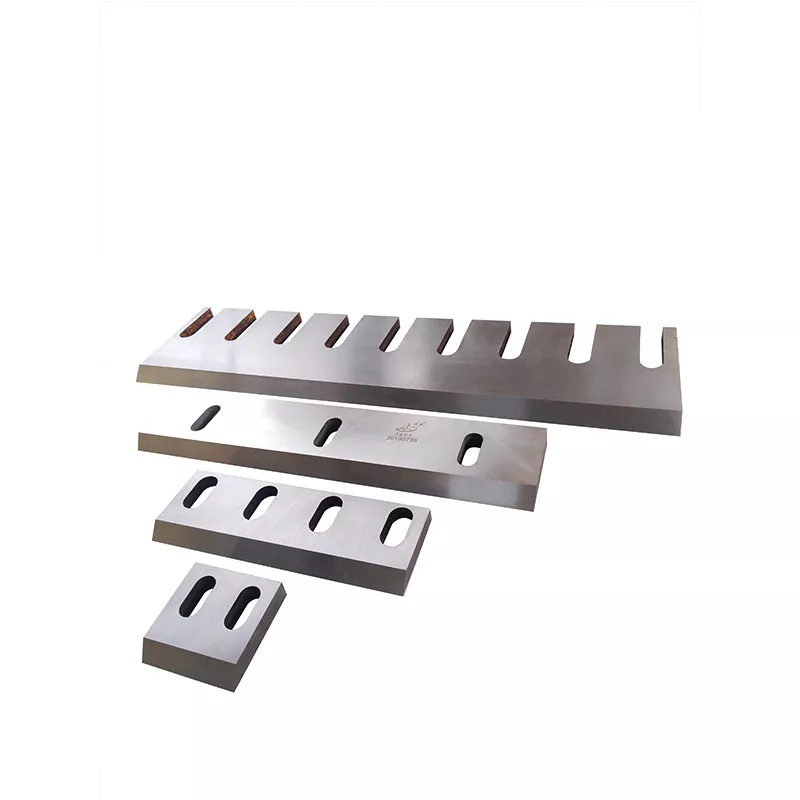
The most fundamental reason for rapid blade wear is the physical difference between hardwood and softwood. Hardwood varieties such as oak, birch, and walnut have compact fiber structures and high density, with dense internal lignin and cellulose components. When crushing, the blades need to apply far more cutting force to tear and break the tough wood fibers compared with loose softwood materials. Long-term high-load cutting continuously consumes the blade’s sharp edge, leading to rapid blunting.
Most raw hardwood waste comes from construction lumber, furniture factories, or forest harvesting residues. These materials often contain invisible impurities, including tiny sand particles, metal nails, rust fragments, and mineral deposits. Hardwood has a tighter texture that easily traps foreign matter inside the fiber gaps. Every crushing cycle creates friction and impact between the blade and hard impurities, causing micro-scratches and edge chipping that accelerate blade aging.
Most universal crusher blades for wood are designed for general softwood and ordinary wood waste crushing. Their hardness and toughness balance are optimized for low-resistance cutting scenarios. When facing high-resistance hardwood cutting, the blade edge cannot withstand continuous strong friction and impact. Ordinary alloy steel blades will gradually wear thin at the cutting edge, and severe cases will result in edge collapse and cracking, forcing early replacement.
Unreasonable daily operation also aggravates blade wear. Many production lines use a unified crushing speed for all wood materials. Hardwood requires a slower cutting speed and longer crushing cycle, but running the machine at high speed for hardwood leads to violent friction and instantaneous pressure overload. In addition, feeding unevenly or overloading the crusher will cause single-point stress concentration on the blade, forming localized wear and reducing overall service life.
Understanding the wear causes allows operators to adjust processing methods and effectively extend blade service life. First, replace general blades with high-hardness alloy blades specially customized for hardwood processing, which can resist high friction and tough fiber cutting pressure.
Second, add a pre-screening process before crushing to remove sand, metal impurities and sundries in hardwood raw materials, avoiding hard foreign matters from scratching the blade edge. Adjust the crusher’s operating speed appropriately according to wood hardness, and maintain uniform and stable feeding to prevent equipment overload operation. Regular blade cleaning and sharpening can also restore cutting performance and reduce unnecessary replacement costs.
Blade wear is a normal mechanical loss, but rapid premature wear is avoidable. By matching professional blade materials, optimizing processing parameters and removing impurities in advance, you can greatly slow down the wear speed and extend blade service life significantly.
It is not recommended. Ordinary blades have limited hardness and impact resistance. Long-term hardwood processing will cause frequent blunting and chipping, increase production downtime and replacement costs, and even affect crushing particle size uniformity.
For continuous hardwood production, it is recommended to inspect and sharpen the blades every 7 to 10 days. Timely sharpening removes passivated edges, ensures cutting efficiency, and avoids aggravated wear caused by blunt blade forced cutting.
High-chromium alloy steel and tungsten carbide composite blades are the best choices. These materials have higher hardness and impact resistance than ordinary manganese steel blades, perfectly adapting to high-strength cutting and friction scenarios of dense hardwood.


